
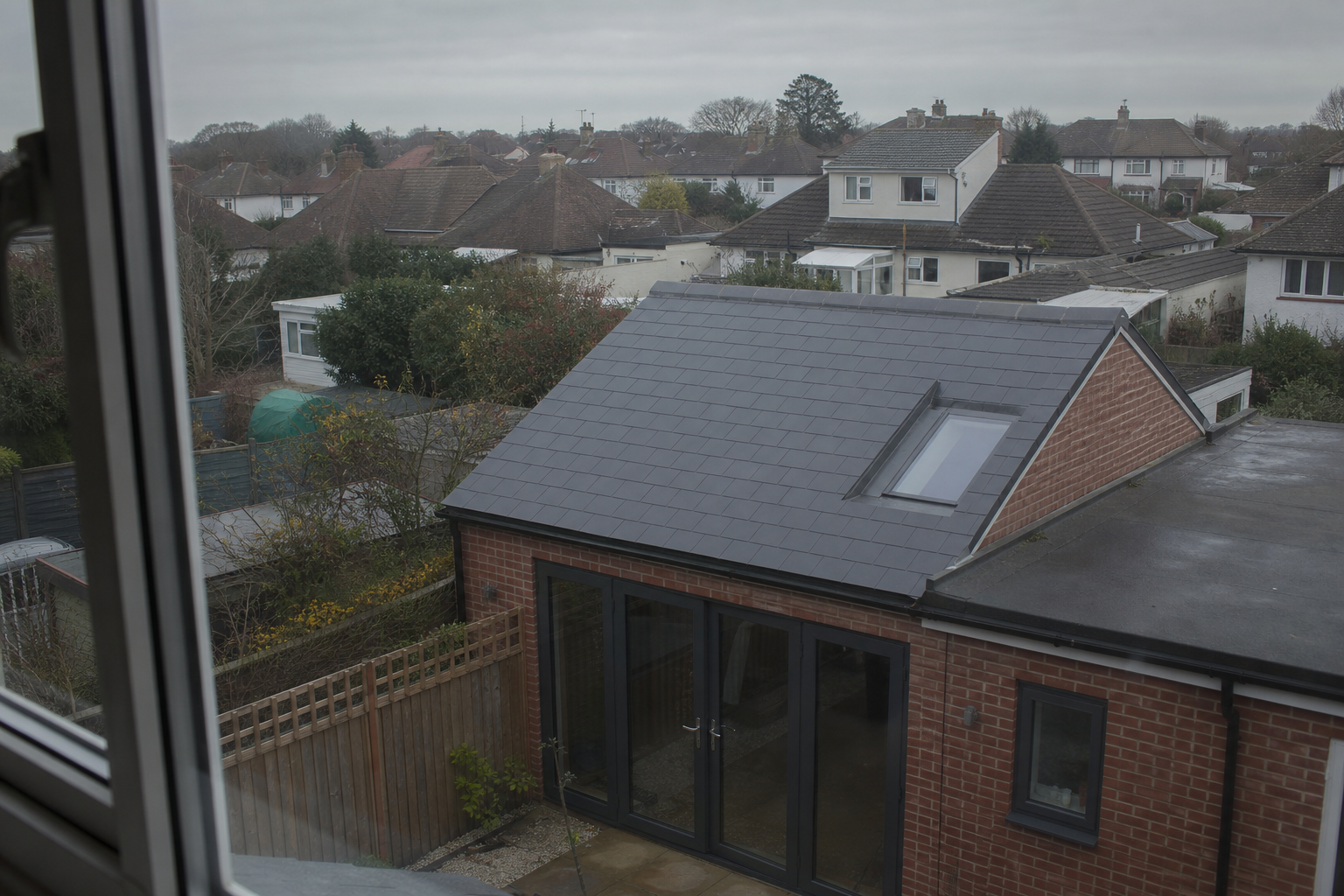
England & Wales — not legal advice. Planning applications for garage to annexe or outbuilding to annexe conversions generate a large volume of neighbour queries. The planning law position is often misunderstood: whether permitted development (PD) rights apply, what neighbours can actually argue, and — crucially — what conditions the LPA may impose. This guide explains each step.
Does a garage-to-annexe conversion need planning permission?
The answer depends on what is being proposed and where.
Scenario 1: Internal conversion only (no external changes) Internal works that do not alter the external appearance often do not need planning permission under the Town and Country Planning (General Permitted Development) (England) Order 2015. The key is that the use of the resulting space must remain ancillary to the dwellinghouse — part of the same home, not a separate dwelling. If this is the route the applicant is taking, there may be no application on the register and therefore no formal consultation right.
Scenario 2: External alterations plus conversion External changes — a new door, window, rooflight, or roofline alteration — may require a householder planning application. This is when the application appears on the public planning register and neighbours can comment formally.
Scenario 3: Creating an independent annexe (separate self-contained dwelling) If the resulting unit could function as a separate dwelling — its own kitchen, bathroom, separate access, lettable independently — it moves outside Class C3 dwellinghouse use and normally requires full planning permission. This is the scenario that most commonly concerns neighbours.
For the permitted development route and prior approval, see permitted development: a neighbour's guide. For lawful development certificates (LDCs) used to confirm conversions are lawful, see LDCs explained.
What is an "annexe" in planning terms?
Planning policy does not provide a single statutory definition of "annexe." In practice, LPAs assess whether a proposed unit is:
- Ancillary to the main dwelling (one planning unit — treated as part of C3 use), or
- A separate dwelling in its own right (a new C3 unit requiring its own permission, sometimes sui generis if intended for multiple unrelated households).
Factors pointing toward a separate dwelling — and therefore toward requiring permission:
- Separate external access not through the main house.
- Self-contained kitchen facilities.
- No internal connection to the main house.
- Design that makes independent occupation clearly intended (own postbox location, separate services, etc.).
- Planning statement wording suggesting an intention to let or sell separately.
Material grounds for objecting to a garage-to-annexe application
Design and character of the area
Is the conversion visually in keeping with the street scene and the character of the surrounding area? Local design policies often protect the rhythm of streets and building lines — garages converted to habitable space with new front-facing windows, raised ground levels, or extensions can conflict with these.
Cite the relevant local plan design policy (search your LPA's website), the streetscape as shown on the validated drawings, and any character appraisal or design SPD adopted locally. If the site is in a conservation area, see Green Belt & heritage for additional arguments.
Parking loss and highway impact
Converting a garage to habitable space often removes an on-site parking space. If the area already has parking pressure — on-street demand, restricted hours, or a local plan policy protecting minimum parking levels — this is a material argument.
Evidence: note the drawing reference for the parking plan. Compare with your authority's parking standards SPD or local plan transport policy. Measure distances to the nearest alternative parking if relevant. See highways and parking guide.
Overlooking and loss of privacy
New windows — particularly at first-floor level or on side and rear elevations — pointing toward habitable rooms or private gardens of neighbouring properties are a standard amenity concern. Reference:
- The elevation drawings with confirmed window positions.
- Distances from new windows to your rear garden or habitable room windows.
- Your council's distance standards if any are adopted in the design SPD (commonly around 21 metres back-to-back for facing habitable rooms — but check your specific council).
For detailed guidance on daylight and distance evidence, see loss of light and overshadowing.
Overbearing impact and loss of outlook
If the conversion involves raising the roofline or adding a substantial dormer, assess whether the resulting form is overbearing or dominant in relation to immediately adjacent properties. Cross-sections from the validated drawings showing the relationship between the new roof height and neighbouring windows or garden spaces are useful here.
Cumulative impact on parking and character
Where garages are systematically converted across a street or estate, there can be cumulative pressure on parking and the character of an area designed at a certain density. Some LPAs have specific policies on back-land or garden land development — worth checking in your local plan.
Occupancy conditions: what to argue for
If you cannot secure a refusal but want to limit harm, ask the LPA to impose a condition requiring:
- The annexe is occupied only in association with the main dwellinghouse at [address] and is not let or sold separately.
- Removal of the kitchen facilities if the unit is separated from the main house.
- A Construction Management Plan if parking or access will be disrupted during works.
This is sometimes called a "tied occupancy" condition or "ancillary use" condition. Planning conditions must be reasonable, enforceable, and necessary — reference the PPG on conditions if you want to suggest specific wording to the officer.
How to structure your garage-to-annexe objection letter
Step 1: Read the application Identify the planning route (full permission, prior approval, or PD claim). Confirm the exact external changes shown on validated drawings.
Step 2: Establish whether a separate dwelling is created If yes, argue this is not covered by PD. If planning permission is sought, argue for an occupancy condition.
Step 3: Identify your strongest material ground(s) Design, parking, overlooking, or character — pick the one or two strongest and evidence them with drawing references and policy citations.
Step 4: Write using the policy → fact → consequence structure See planning objection letter structure.
Step 5: Submit and keep proof Follow your LPA's portal route and retain a copy with submission timestamps. See planning objection deadlines.
Frequently asked questions
Can a neighbour object to a garage conversion that doesn't need planning permission?
If the works are genuinely PD and no application is required, there is no formal consultation and no planning mechanism to lodge a representation. Your options are limited to checking whether PD rights actually apply (an LDC can confirm legality) or reporting a breach to enforcement if works go beyond what is lawful. See planning enforcement vs objecting.
What condition prevents an annexe becoming a separate house?
A tied occupancy condition typically reads: "The annexe hereby permitted shall be occupied only in connection with the main dwellinghouse at [address] and shall not be sold, let, or used as a separate dwelling." Ask the LPA to impose this in your representation if the development is likely to be approved.
Is a garden room or outbuilding conversion treated differently?
Sometimes yes. Outbuildings in the curtilage of a dwellinghouse may have separate PD rights under Part 1, Class E of the GPDO. Whether an outbuilding conversion to ancillary use requires permission depends on whether it involves a material change of use — check with your LPA or seek professional planning advice.
For a structured starting point, run a free scan then see pricing for an editable PDF or Word draft — not legal advice.
More from this series
- Loss of privacy & overlooking planning objections (UK neighbour guide)
- Right to light vs planning objection: what neighbours need to know (UK)
- Reasons to object to planning permission (UK): what actually counts
- What happens after the planning objection deadline? (UK)
- How to find planning applications near me (UK)
- Planning objection letter template (UK)
- What counts as a material change of use in planning law? (England guide)
- Your rights as a neighbour during construction after planning permission is granted (UK)
When you are ready to turn this into a structured objection draft, start with the free material-grounds scan — no account needed to scan.
Email updates
Get occasional emails when we publish new planning guides and product updates. No spam — unsubscribe in one click from any message.
Explain your concerns clearly and in your own words
Free material-grounds scan — see what may count as material planning considerations. Optional editable letter from £7.99; you submit to the council yourself.Planning Guard is a drafting aid, not legal advice.
Not legal advice. Planning Guard is a planning tool to help you explore material planning issues and draft letters — not a solicitor or planning consultant. See Terms.