
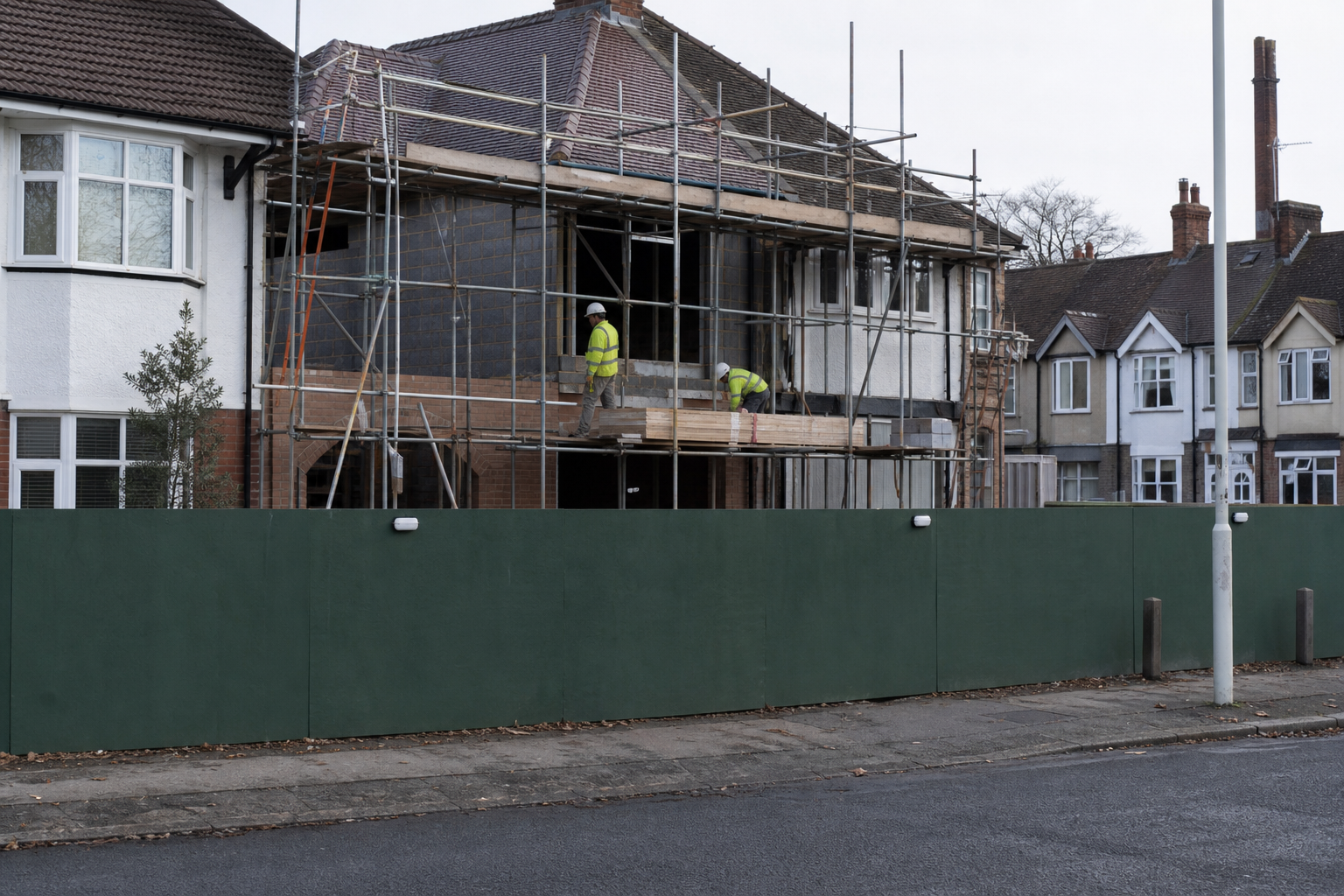
Loft conversions are one of the most common sources of neighbour disputes in English planning. If your neighbour has applied for permission to convert their roof space, or if you suspect a conversion that has been built without it, this guide explains what your council can and cannot consider, and how to make a representation that carries weight.
Does a loft conversion need planning permission?
Not always. In England, most straightforward loft conversions fall within permitted development (PD) rights under Class B of Schedule 2, Part 1 of the Town and Country Planning (General Permitted Development) (England) Order 2015. This means the homeowner can build without applying for planning permission — provided the conversion stays within specific limits.
Key permitted development limits for loft conversions in England:
- Enlarged roof space must not exceed 40 cubic metres for terraced houses, or 50 cubic metres for detached and semi-detached houses (compared to the original roof volume)
- The conversion must not exceed the existing roof ridge height
- No part should protrude beyond the plane of the existing roof slope on the principal elevation facing a highway
- Any dormer on a side elevation must use obscure glazing and be fixed-frame or top-hung only
- Materials must be similar in appearance to the existing house
Permitted development rights do not apply when the property is in:
- A conservation area, National Park, Area of Outstanding Natural Beauty, or World Heritage Site — where roof extensions visible from a highway always need a planning application
- A property covered by an Article 4 direction removing Class B rights
- A listed building — which requires listed building consent for any alterations
If the loft conversion falls within PD limits, the council has no planning jurisdiction. You cannot object through the planning system. You may still have separate rights under the Party Wall etc. Act 1996, but that is a civil matter entirely separate from planning.
When will a loft conversion require a planning application?
Planning permission is required when:
- The conversion exceeds PD volume or design limits (for example, a large rear dormer on a detached house that pushes above the 50m³ threshold)
- The property is in a designated area where roof PD rights are restricted
- The council has issued an Article 4 direction removing roof extension rights — common in some conservation areas and streets of strong character
- The conversion affects a listed building (listed building consent required)
If a formal application is submitted, your council will publish it on their planning register with a consultation period (usually 21 days). You will have the opportunity to comment.
Material planning grounds for objecting to a loft conversion
If the application requires planning permission, only material planning considerations carry weight. Personal dislike of the design or concern about property values are not material. Valid grounds include:
Overlooking and loss of privacy
Rooflights and dormer windows at roof level can create direct sight lines into neighbouring gardens, living rooms, and bedrooms that did not previously exist. To be material, overlooking must be significant and direct — not merely theoretical.
To strengthen this ground: identify the window type and orientation, estimate the angle and distance to overlooked spaces, and reference your council's local plan privacy standards (often a minimum 21-metre back-to-back separation between facing windows, though criteria vary by authority).
Loss of daylight and sunlight
A large rear dormer can cause measurable reductions in daylight to an adjoining property's windows, particularly where properties are close together. The BRE guidelines (Daylight and Sunlight: a guide to good practice, 2022) provide the technical framework councils apply.
Without technical evidence, loss of light alone is difficult to sustain. If you believe the impact is material, reference the BRE methodology. For a fuller treatment see loss of light and overshadowing planning objections.
Impact on the character and appearance of the area
NPPF Chapter 12 (Achieving Well-Designed Places) and most local design policies require development to respect the character of the surrounding area. A bulky, poorly detailed dormer on a uniform terrace of unaltered rooflines may conflict with this test.
In conservation areas, the policy bar is higher: the council must preserve or enhance the character and appearance of the area. A dormer that breaks the established roofline in a historic streetscape can be a substantive ground — particularly where the council has a conservation area appraisal identifying roofscape as a key feature.
Heritage impact
If the property is listed or adjacent to one, heritage impact is a separate and significant consideration. Historic England's advice on new work in historic settings sets out how setting assessments should be approached. Listed building consent is a separate consent from planning permission.
Design quality
Poorly detailed dormers — wrong materials, disproportionate scale, clashing roof form — can be resisted on design grounds. Reference your council's residential extensions SPD or design guide if one is adopted.
What you cannot object to
The following are not material planning considerations and will not be given weight:
- Loss of a view — there is no legal right to a view over a neighbour's roof
- Reduced property value — planning policy does not protect private economic interests
- Boundary or land ownership disputes — civil law, not planning
- Party wall concerns — dealt with separately under the Party Wall etc. Act 1996
- Personal objection to the neighbour or their building project
Article 4 directions and conservation area controls
Some councils have used Article 4 directions to remove PD rights for loft conversions in specific streets or areas — typically where uniform rooflines are central to neighbourhood character. Check your council's planning portal or policy pages for active Article 4 directions. In conservation areas, any roof extension visible from a highway already requires a planning application, giving you automatic access to the consultation.
How to find the application
Search your council's planning portal using the neighbour's address or postcode. See how to search for planning applications by postcode for step-by-step guidance. Some portals allow you to register for email alerts when new applications are received near your address.
How to write your objection
If the loft conversion goes through the planning process:
- Confirm the application reference and your interest as an adjoining owner
- Set out material grounds only — overlooking, daylight, design, heritage — each in a separate numbered paragraph
- Reference specific policies — your local plan policies and relevant NPPF paragraphs
- Provide evidence — photographs, measurements, technical reports where available
- Submit before the consultation deadline
For a detailed structure guide, see how to write a planning objection letter and planning objection letter examples.
Frequently asked questions
Can I stop a loft conversion that is permitted development?
No. If the conversion falls within PD limits and no Article 4 direction applies, the council has no planning jurisdiction over it. You may have separate rights under the Party Wall etc. Act 1996 if the works affect a shared wall, but that is a civil matter.
What if the loft conversion has already been built without planning permission?
If you believe permission was required and not obtained, report it to your council's planning enforcement team. The council can investigate and, if a breach is confirmed, may serve an enforcement notice requiring removal or alteration. See planning enforcement vs objecting for details.
Are side dormers treated differently from rear dormers?
Yes. Under PD rules, dormers on side elevations facing a highway are not permitted. Side dormers on other elevations must use obscure glazing. Rear dormers are more permissive in terms of design limits but may still raise overlooking or daylight concerns depending on proximity to neighbouring windows.
Does a loft conversion affect building regulations?
Yes — building regulations govern structural integrity, fire safety, insulation, and means of escape. These are separate from planning and enforced by building control. Objections on building regulation grounds are not material in planning terms.
If your neighbour's loft conversion does go to planning, use Planning Guard's free material-grounds scan to identify which policy arguments are strongest for your case, then consider an editable PDF or Word letter draft you can submit yourself — not legal advice; verify all citations before lodging.
More from this series
- Loss of privacy & overlooking planning objections (UK neighbour guide)
- Right to light vs planning objection: what neighbours need to know (UK)
- Reasons to object to planning permission (UK): what actually counts
- What happens after the planning objection deadline? (UK)
- How to find planning applications near me (UK)
- Planning objection letter template (UK)
- What counts as a material change of use in planning law? (England guide)
- Your rights as a neighbour during construction after planning permission is granted (UK)
When you are ready to turn this into a structured objection draft, start with the free material-grounds scan — no account needed to scan.
Email updates
Get occasional emails when we publish new planning guides and product updates. No spam — unsubscribe in one click from any message.
Explain your concerns clearly and in your own words
Free material-grounds scan — see what may count as material planning considerations. Optional editable letter from £7.99; you submit to the council yourself.Planning Guard is a drafting aid, not legal advice.
Not legal advice. Planning Guard is a planning tool to help you explore material planning issues and draft letters — not a solicitor or planning consultant. See Terms.