
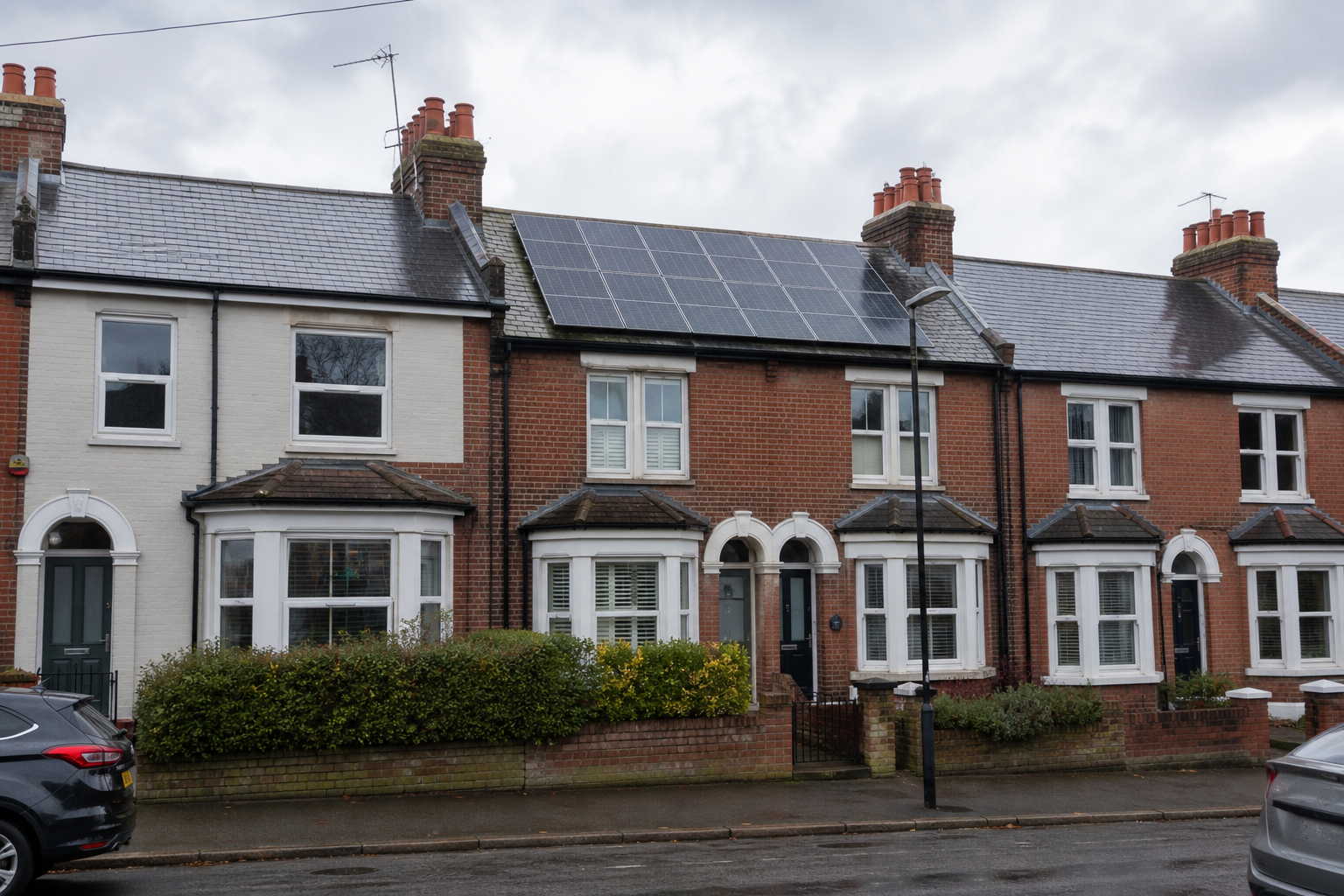
Quick answer
Can neighbours object to solar panels?
Often partly — many roof panels are permitted development, but listed buildings, conservation areas, flat roofs, and prior approval routes can still give you a say. Glare from neighbours' solar panels can be material where you evidence direction, height, and reflective impact on your rooms or garden.
Related: permitted development objections · letter structure · sample letter
Solar Panels and Planning: A Neighbour's Guide (England and Wales)
Key Takeaways
- Most rooftop solar installations on homes fall within permitted development rights and do not require planning permission — but important exceptions apply.
- Listed buildings, conservation areas, flat roofs, and ground-mounted arrays all have different rules.
- If a planning application has been submitted for solar panels, your objection must focus on material planning considerations — not general objection to renewable energy.
- Use Planning Guard to scan the application and identify any heritage or design policy grounds that apply.
Solar panels on neighbouring properties generate questions about planning rights, visual impact, and glare. The starting point is almost always permitted development — but the picture changes significantly in sensitive locations. This page explains when planning permission is needed, when a neighbour's objection can carry weight, and what material arguments look like.
When Do Solar Panels Need Planning Permission?
For most domestic installations on sloping roofs, solar panels fall within permitted development rights subject to specific limits. GOV.UK's When is permission required hub covers domestic microgeneration, including solar panels. The key criteria for PD rights on a house roof typically include:
- Panels do not protrude more than a specified distance above the roof slope.
- Installation is not on a wall forming an elevation visible from the highway (in some cases).
- The dwelling is not a listed building.
- The installation is not on a building in certain designated areas.
These details change — always verify against the current national legislation and GOV.UK guidance.
Exceptions Where Permission Is Required
Planning permission is generally required — or is likely to require careful scrutiny — for:
- Listed buildings — listed building consent may also be required in addition to (or instead of) planning permission.
- Conservation areas — additional restrictions on roof-mounted panels facing a highway.
- Flat roofs — the PD rules for flat roofs differ from those for sloping roofs; larger panels may be treated as roof-mounted structures requiring permission.
- Ground-mounted arrays — subject to separate PD rules based on size, location, and proximity to curtilage boundaries. Larger ground arrays almost always require planning permission.
- Commercial and industrial buildings — separate rules apply; domestic PD does not carry across.
When Can a Neighbour's Objection Carry Weight?
If a planning application has been submitted for solar panels (because PD rights do not apply), your objection must focus on material planning considerations. General objection to renewable energy does not carry planning weight — the NPPF and government policy actively support low-carbon technology. Material arguments in this context might include:
Heritage and Conservation Area Impact
If the installation is in a conservation area or affects a listed building:
- Does the panel location harm the character and appearance of the conservation area?
- Is the installation visible from public vantage points in a way that local policy restricts?
- Does the heritage statement (if submitted) accurately assess the significance of the building and the impact of the proposed installation?
See Green Belt, conservation areas, and listed buildings for the heritage framework.
Design and Landscape
For ground-mounted arrays:
- Does the installation conflict with landscape character policies?
- Does it affect agricultural land designated under local plan policy?
- Does it harm biodiversity or ecological features on the site?
See biodiversity net gain if biodiversity policies apply.
Glare and Light Pollution
Glare from solar panels is rarely decisive as a planning concern — modern panels are specifically designed to minimise glare, and decision-makers are generally unsympathetic to glare claims without specific technical or policy framing. If you intend to raise glare:
- Reference any specific design code or policy guidance that addresses solar glare.
- Provide technical evidence rather than speculation.
- Acknowledge that the claim will be tested against modern panel specifications.
What Usually Does Not Work
- "It looks ugly" without a design code or heritage policy hook — aesthetic preference alone is not a material consideration.
- General opposition to solar energy — renewable energy is supported by national policy.
- Speculation about glare without technical or policy grounding.
- Objecting to PD installations — there is no consultation process for permitted development solar installations.
Get a Heritage-Focused Solar Objection Drafted
If the application involves a heritage or conservation area concern, Planning Guard can identify the relevant policies and produce a structured objection.
Free material-grounds scan → | View pricing
Frequently Asked Questions
Do solar panels on a house always need planning permission?
No. Most rooftop solar installations on domestic properties fall within permitted development rights and do not require planning permission. Key exceptions include listed buildings, certain installations in conservation areas, flat roof installations above specific sizes, and ground-mounted arrays above permitted development thresholds.
Can I object to my neighbour's solar panels?
If a planning application has been submitted for the solar panels (because PD rights do not apply), you can comment during the consultation. Your objection must focus on material planning considerations — heritage impact, landscape, biodiversity — not general objection to renewable energy.
Are solar panels allowed in conservation areas?
Rooftop solar panels are subject to additional restrictions in conservation areas in England and Wales. Panels on roofs that face and are visible from the highway generally require planning permission in a conservation area. Check the current PD rules and your LPA's conservation area guidance.
What about solar glare from my neighbour's panels?
Glare from modern solar panels is engineered to be minimal, and planning officers are generally unsympathetic to glare objections without specific technical evidence and a policy link. If you have a genuine glare concern, you would need to provide technical evidence rather than speculation.
Can I report a solar panel installation that was installed without permission?
If you believe solar panels were installed without the required planning permission, report it to your LPA's planning enforcement team. The enforcement team can investigate whether the installation required permission and, if so, whether it was lawfully obtained.
Free material-grounds scan — new case.
More from this series
- Loss of privacy & overlooking planning objections (UK neighbour guide)
- Right to light vs planning objection: what neighbours need to know (UK)
- Reasons to object to planning permission (UK): what actually counts
- What happens after the planning objection deadline? (UK)
- How to find planning applications near me (UK)
- Planning objection letter template (UK)
- What counts as a material change of use in planning law? (England guide)
- Your rights as a neighbour during construction after planning permission is granted (UK)
When you are ready to turn this into a structured objection draft, start with the free material-grounds scan — no account needed to scan.
Email updates
Get occasional emails when we publish new planning guides and product updates. No spam — unsubscribe in one click from any message.
Explain your concerns clearly and in your own words
Free material-grounds scan — see what may count as material planning considerations. Optional editable letter from £7.99; you submit to the council yourself.Planning Guard is a drafting aid, not legal advice.
Not legal advice. Planning Guard is a planning tool to help you explore material planning issues and draft letters — not a solicitor or planning consultant. See Terms.