
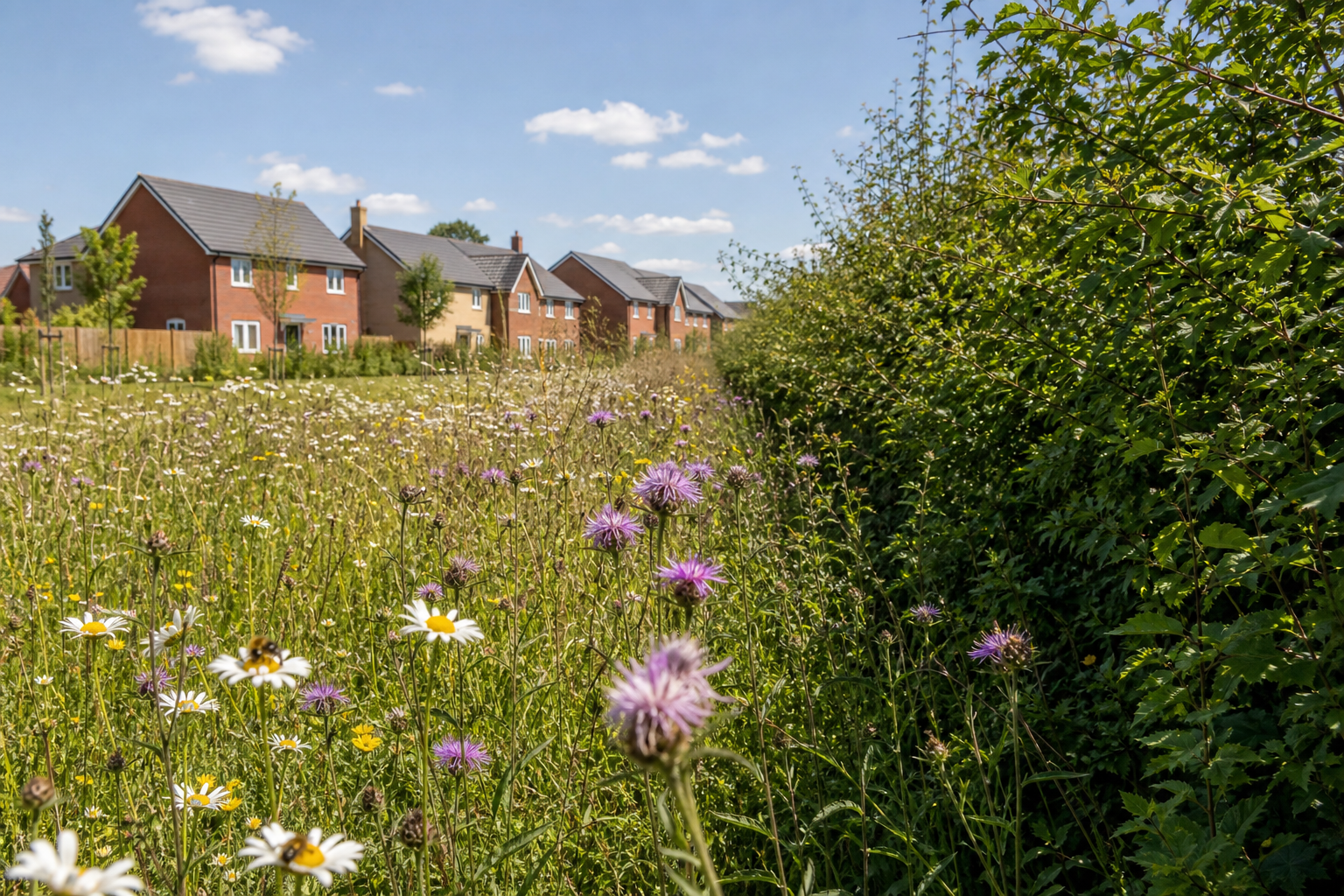
England — not legal advice. Biodiversity net gain (BNG) is a planning requirement that means new development must leave biodiversity in a measurably better state than before. From 2024, most major developments in England must achieve a minimum of 10% biodiversity net gain as a condition of planning permission. Understanding BNG helps objectors know what the council should be requiring of developers — and where the ecology assessment for a development may fall short.
This page is England-focused. Wales, Scotland, and Northern Ireland run different systems; verify current requirements on official government sources for those jurisdictions.
For the broader context on planning policy, see planning policy essentials and material planning considerations. For tree and habitat concerns more broadly, see trees and TPOs in planning.
What biodiversity net gain requires
Under the Environment Act 2021, the net gain condition is a mandatory pre-commencement requirement for most planning permissions in England. This means:
- The developer must produce a biodiversity metric calculation (using Natural England's statutory biodiversity metric tool) showing the on-site biodiversity value before and after development
- The development must achieve at least 10% BNG — meaning the post-development biodiversity value must be at least 10% higher than the pre-development value
- Where the 10% cannot be achieved on-site, the developer can use off-site BNG units (purchased from verified BNG sites) or, as a last resort, statutory biodiversity credits from the government
- The biodiversity gains must be maintained for at least 30 years, secured by a legal agreement or planning condition
Which developments must achieve BNG
The mandatory BNG requirement applies to:
- Major development (10 or more dwellings, or 0.5 hectares or more for residential; 1,000 square metres or more floorspace for non-residential) — from February 2024
- Small sites (including minor residential and non-residential development) — from April 2024
Exempt development includes householder applications (extensions, outbuildings), development that affects habitat of negligible biodiversity value, permitted development, and some nationally significant infrastructure.
Where an application falls within the exemptions, BNG is not a mandatory requirement — but the NPPF still encourages net gains for biodiversity on all development.
The biodiversity metric
The statutory biodiversity metric (currently version 4.0, produced by Natural England) calculates biodiversity value by assessing the type, condition, and area of habitats on a site. The tool produces a baseline biodiversity unit value and a post-development projected value. The difference expresses the gain or loss.
Applications must include a completed biodiversity metric calculation and a biodiversity gain plan. For major development, a formal biodiversity gain plan must be approved by the LPA as a pre-commencement condition.
When reviewing an application's ecology documents, check:
- Has a baseline habitat survey been carried out, and does the method appear appropriate for the season and site type?
- Does the metric calculation include all habitats on and adjoining the site that may be affected?
- Are the habitat condition assessments credible given what you know about the site?
- Does the BNG plan identify credible on-site enhancements, or is it heavily reliant on off-site units or statutory credits?
BNG does not replace site-specific ecology requirements
The mandatory BNG requirement is a floor — a minimum standard — not a ceiling. It does not replace the need to consider specific ecology matters that are material to the application.
Protected species — development affecting bats, great crested newts, badgers, nesting birds, and other protected species requires specific assessment and mitigation regardless of BNG. A European Protected Species mitigation licence (from Natural England) may be required before work can start.
Ancient woodland and veteran trees — the NPPF affords the highest level of protection to irreplaceable habitats including ancient woodland and ancient and veteran trees. Development resulting in the loss or deterioration of ancient woodland should be refused unless there are wholly exceptional reasons. BNG cannot compensate for the loss of irreplaceable habitats.
Local biodiversity policies — many local plans contain policies protecting specific habitats (local wildlife sites, priority habitats, green corridors) that go beyond the mandatory BNG requirement. Check whether your local plan identifies any such designations on or near the application site.
Ecological connectivity — a development that severs a known ecological corridor or green link may harm biodiversity even if it achieves 10% BNG on-site. Where your local plan or green infrastructure strategy identifies ecological networks, this is a relevant consideration.
What to look for in the ecology documents
Most applications above a certain scale should include at minimum:
- A preliminary ecological appraisal (PEA) assessing habitats and identifying potential for protected species
- Further surveys where the PEA identifies reasonable likelihood of protected species (bat transect surveys, great crested newt presence/absence surveys, bird breeding surveys, etc.)
- A biodiversity metric calculation (for non-exempt applications)
- A biodiversity gain plan (for major development)
If the ecology documents are absent, limited to a brief desk study, or based on surveys carried out at the wrong time of year — bats must be surveyed in summer; great crested newts in spring — this is a relevant point to raise.
Raising a BNG or ecology objection
Structure your ecology objection as follows:
- Identify the gap — which survey is missing, or what does the submitted metric appear to undervalue?
- Link to policy — which local plan policy, NPPF paragraph, or statutory requirement is relevant?
- Cite the evidence — what do you know about the site's ecology (habitats, species, historical records)?
- Request the outcome — refusal pending further survey, or condition requiring ecological surveys and BNG plan approval before commencement?
General statements that development is bad for wildlife are less effective than specific challenges to the submitted ecology assessment.
The government's BNG guidance is at GOV.UK — Biodiversity net gain. Natural England's biodiversity metric tool and guidance are at Natural England — biodiversity metric.
Planning Guard's free scan identifies material planning grounds — including ecology and BNG — for your specific case. Not legal advice; verify ecology survey requirements against current Natural England guidance.
More from this series
When you are ready to turn this into a structured objection draft, start with the free material-grounds scan — no account needed to scan.
Email updates
Get occasional emails when we publish new planning guides and product updates. No spam — unsubscribe in one click from any message.
Explain your concerns clearly and in your own words
Free material-grounds scan — see what may count as material planning considerations. Optional editable letter from £7.99; you submit to the council yourself.Planning Guard is a drafting aid, not legal advice.
Not legal advice. Planning Guard is a planning tool to help you explore material planning issues and draft letters — not a solicitor or planning consultant. See Terms.