
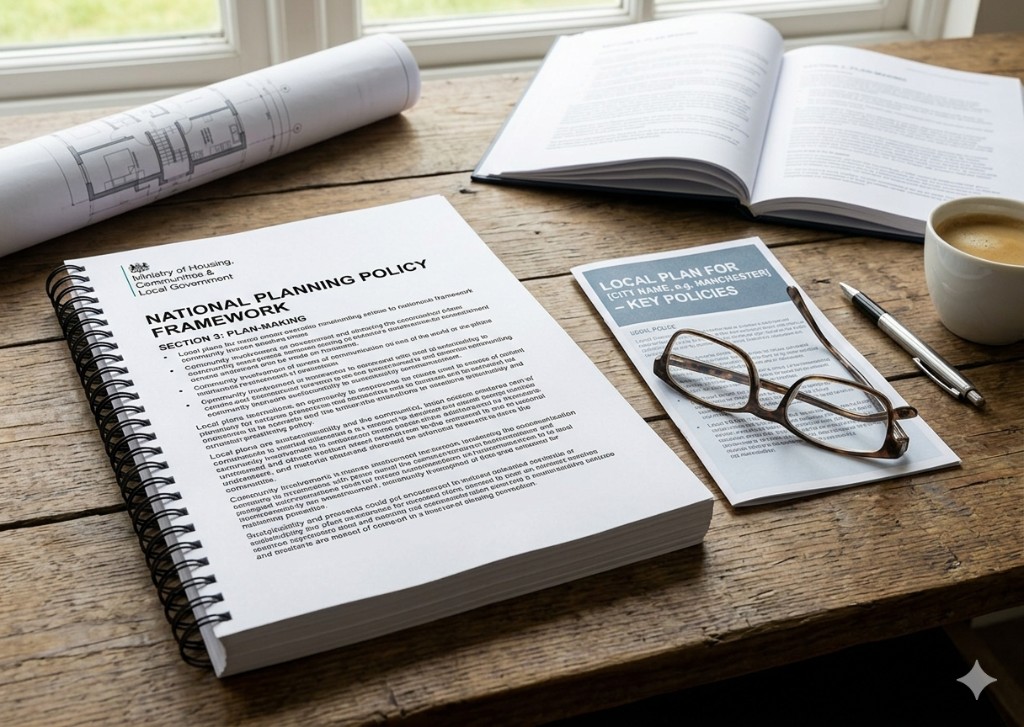
England — not legal advice. If you want an objection or objection letter to carry weight, you need to speak the language decision-makers use: the development plan, material planning considerations, and — where relevant — the National Planning Policy Framework (NPPF). This guide explains the policy hierarchy, how to find your local plan, how to read supplementary documents, and how to tie policy arguments to the specific application you are objecting to.
Start the practical journey here: how to object to a planning application. To identify which material considerations apply to your case, see material planning considerations.
The planning policy hierarchy in England
Planning decisions in England are made in accordance with a layered policy hierarchy. Understanding this helps you identify which policy level is most useful for your specific objection.
1. The development plan
The development plan is the starting point for every planning decision. Under section 38(6) of the Planning and Compulsory Purchase Act 2004, a local planning authority must determine applications in accordance with the development plan unless material considerations indicate otherwise.
The development plan for any given site usually consists of:
- The adopted local plan — the primary policy document for your area
- Any neighbourhood plan that has been "made" (formally adopted following a referendum) in the relevant area
- Any saved policies from older development plans that remain in force
- The London Plan (for Greater London sites) or equivalent combined authority spatial strategies where they form part of the development plan
2. The National Planning Policy Framework (NPPF)
The NPPF sets out national planning policies for England. It is a material consideration in planning decisions and is particularly influential where the development plan is silent on a topic, where the plan is out of date, or where applying it would produce results inconsistent with national policy.
The current NPPF is on GOV.UK. It covers housing supply, the presumption in favour of sustainable development, design quality, residential amenity, Green Belt, heritage, natural environment, flooding, climate adaptation, and economic development. For how to use specific paragraphs in an objection, see the NPPF and your objection.
3. Planning Practice Guidance (PPG)
Planning Practice Guidance is published by the government alongside the NPPF. It provides detailed guidance on how national policy should be applied in practice — covering topics such as noise, flood risk, viability, biodiversity net gain, and design. Officers frequently reference PPG in their assessments; knowing what the PPG says on your topic can strengthen your objection.
4. Supplementary planning documents (SPDs)
Supplementary planning documents are produced by local planning authorities to provide more detailed guidance on specific topics. Common SPDs include residential design guides (setting out separation distances, overlooking standards, and height limits), parking standards, and heritage and conservation area guidance. SPDs carry weight as a material consideration but cannot create policy that conflicts with the local plan.
5. Neighbourhood plans
Where a neighbourhood plan has been made, it becomes part of the development plan and carries statutory weight alongside the local plan. Made neighbourhood plans are material to all decisions in the neighbourhood area and can be more restrictive than the local plan on design, density, or use.
How to find your local plan
Every local planning authority publishes its adopted local plan on its website:
- Go to your council's website and search for "local plan" or "development plan documents"
- Check whether the plan is "adopted" — draft or emerging plans carry less weight
- Download the policies map and check which designations apply to the application site (conservation area, flood zone, employment land, Green Belt, and so on)
- Note the policy numbers and the exact wording of the tests each policy sets
If your area has multiple plan documents (a core strategy, a detailed policies document, and a site allocations plan, for example), each may contain relevant policies. Officers often cite from all of them.
Neighbourhood plans are listed on the council's website. Check whether one exists for the parish or area covering the application site.
How to use local plan policies in an objection
The most effective planning objection arguments follow a consistent structure:
- Name the policy — give its exact reference number and short title (e.g. "Policy DM4 of the [Council] Development Management Policies 2022 — Residential Amenity")
- Quote the relevant test — what does the policy require?
- Apply it to the facts — how does the application fail the test, with reference to the validated drawings?
- State the conclusion — what outcome do you want (refusal, or specific conditions)?
See how to use local plan policies in a planning objection for a step-by-step method.
Reading supplementary planning documents
SPDs often contain the specific numerical standards that officers use to assess impacts — separation distances, window-to-window distances, height-to-boundary ratios, and daylight angle tests. Where an SPD is adopted, these standards carry weight.
Before you draft your objection:
- Search the council's website for any residential design SPD or design guide applicable to the area
- Check whether the application drawings comply with the numerical standards in the SPD
- If they do not, cite the SPD standard alongside the local plan policy it supplements
For heritage assets and conservation areas, the council's conservation area appraisal carries similar weight. If the site is in or adjacent to a conservation area, download the appraisal and check what it says about the character of the area.
National policy themes most relevant to objectors
| NPPF Chapter | Relevant to objections about… |
|---|---|
| Chapter 2 — Achieving sustainable development | Presumption in favour; when development plan policies are out of date |
| Chapter 4 — Decision-making | Material considerations; conditions |
| Chapter 8 — Promoting healthy and safe places | Noise, air quality, amenity, crime prevention |
| Chapter 12 — Achieving well-designed places | Design quality, local character, heritage settings |
| Chapter 13 — Protecting Green Belt land | Green Belt tests; very special circumstances |
| Chapter 14 — Meeting the challenge of climate change | Flood risk; energy efficiency |
| Chapter 15 — Conserving and enhancing the natural environment | Ecology, biodiversity, trees, landscape |
| Chapter 16 — Conserving and enhancing the historic environment | Listed buildings, conservation areas, scheduled monuments |
Weight given to different policy documents
Highest weight (development plan): Adopted local plan policies; made neighbourhood plan policies.
Significant material weight: The NPPF; Planning Practice Guidance.
Material consideration: Adopted SPDs; conservation area appraisals.
Limited weight: Draft or emerging plans (weight increases as the plan progresses); pre-application advice.
Policy and the planning balance
In most cases, the officer's report assesses the planning balance: whether the harm caused by the application outweighs its benefits. Your job as an objector is to show:
- Which policies the proposal conflicts with and what test each policy sets
- What identifiable harm results from that conflict
- Why the benefits claimed by the applicant do not outweigh that harm
Arguments that tie a specific policy breach to a specific, evidenced harm are the most effective.
Useful starting points by policy topic
- The NPPF and your objection
- Local plan policies you can cite
- Material planning considerations
- Residential amenity objections
- Highways and traffic objections
- Green Belt, heritage, and conservation
- Flooding and drainage
- Biodiversity net gain (England)
- Noise in planning objections
- Trees and TPOs
Verify all policy citations on the council website and GOV.UK before lodging — policy numbers and document status change over time. Planning Guard's free scan identifies which material grounds apply to your specific case. Not legal advice.
Next steps
- Use this hub and the related guides below to shape your material planning points (what matters to the decision).
- Run the free material-grounds scan on your case — quick check of themes before you write.
- Preview the sample objection letter layout (illustrative structure only).
- See letter & toolkit pricing for editable PDF or Word downloads when you are ready to buy.
- If the case may go to a planning committee, see Full Toolkit pricing for a councillor briefing and speaking script after your free scan.
- Use our planning applications near me and other free postcode tools to research constraints, deadlines, and nearby schemes first.
Not legal advice. Planning Guard is a planning tool to help you explore material planning issues and draft letters — not a solicitor or planning consultant. See Terms.
Guides in this hub
Biodiversity net gain: what objectors should know (England)
Updated 2 Jul 2026
BNG as a policy backdrop — not a substitute for site-specific ecology arguments on the application.
Read guide
Green Belt, conservation areas, and listed buildings
Updated 15 May 2026
Link openness or setting harm to NPPF and local plan; use the applicant’s heritage statements.
Read guide
Grey Belt and Green Belt planning objections: NPPF 2024 guide (England)
Updated 2 Jul 2026
Grey Belt land, Planning Practice Guidance, and the 2024 NPPF: how to challenge a grey belt classification, test the golden rules, and build material planning objections under current national policy.
Read guide
HMOs and house conversions: planning in England
Updated 2 Jul 2026
Use classes, permitted development limits, and Article 4 directions — where to read official rules.
Read guide
Local plan policies you can cite
Updated 2 Jul 2026
Adopted plan maps, policy numbers, and site-specific harm beat generic objections.
Read guide
The NPPF and your objection
Updated 2 Jul 2026
Quote specific NPPF paragraphs; link national policy to local plan tests and your site facts.
Read guide
When you are ready to turn this into a structured objection draft, start with the free material-grounds scan — no account needed to scan.
Email updates
Get occasional emails when we publish new planning guides and product updates. No spam — unsubscribe in one click from any message.
Explain your concerns clearly and in your own words
Free material-grounds scan — see what may count as material planning considerations. Optional editable letter from £7.99; you submit to the council yourself.Planning Guard is a drafting aid, not legal advice.
Not legal advice. Planning Guard is a planning tool to help you explore material planning issues and draft letters — not a solicitor or planning consultant. See Terms.