England & Wales — not legal advice. Trees are frequently raised in planning objections — loss of mature trees, harm to root systems, impacts on protected species in canopies, or reduction in the green character of a street or garden. Understanding when trees are a material planning consideration, how Tree Preservation Orders work, and what evidence officers expect from a tree-related objection makes your representation more effective.
For the full process of lodging a planning objection, see how to object to a planning application. For ecology more broadly, see biodiversity net gain.
When trees are a material planning consideration
Trees can be material to a planning decision in several overlapping ways:
Amenity and character — mature trees contribute to the character and appearance of a street, garden, or open space. Where a local plan policy or design SPD requires development to protect or enhance existing green infrastructure or landscape character, the loss of or harm to trees can conflict with that policy.
Biodiversity and ecology — trees may support protected species (bat roosts, nesting birds) or contribute to biodiversity corridors. Where an ecological survey identifies such features, their loss or disturbance is a material consideration.
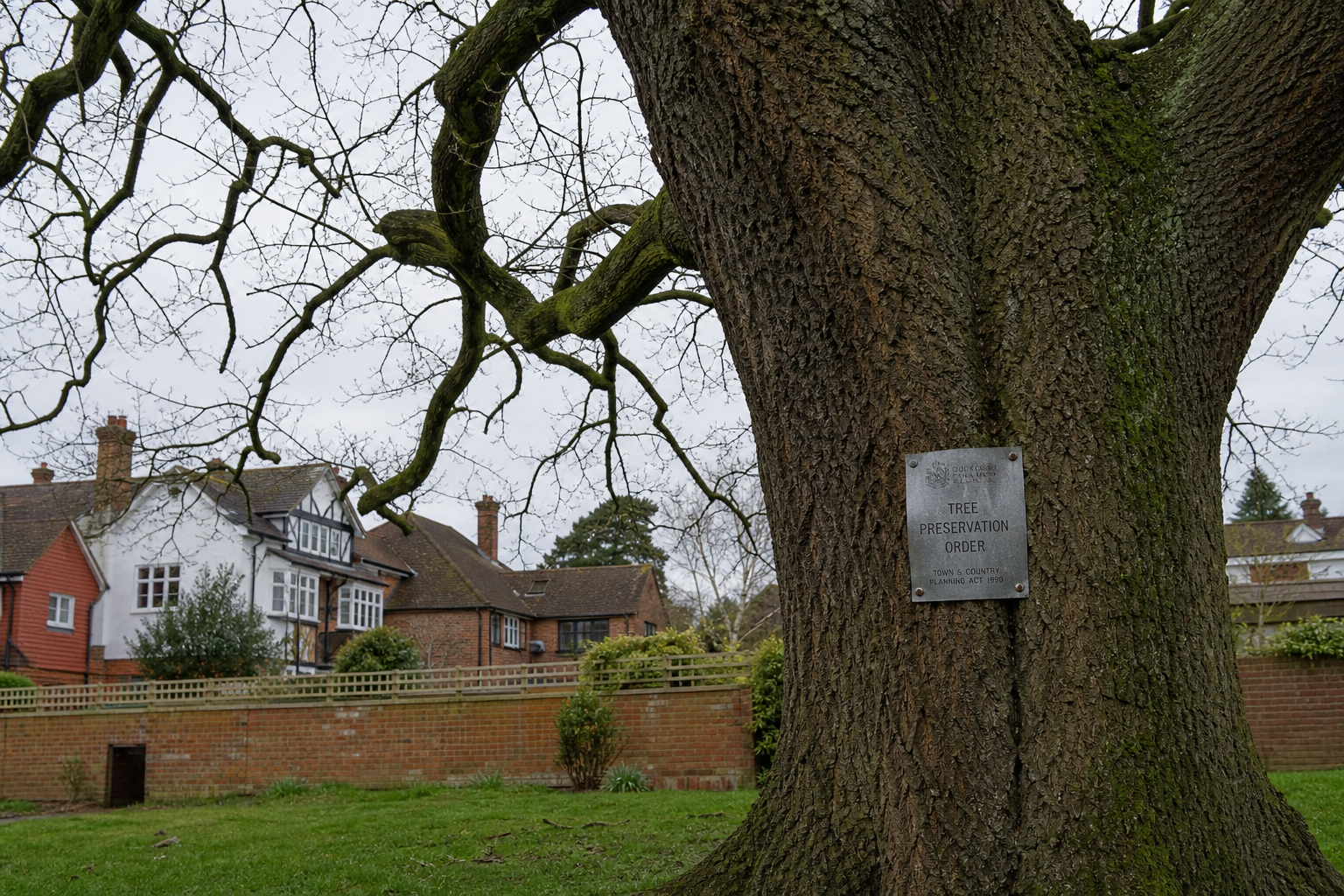
Tree Preservation Orders — where a tree is protected by a TPO, any works to it require separate consent. The loss of a TPO tree to accommodate a development is a significant material consideration.
Conservation areas — in conservation areas, all trees with a trunk diameter of 75mm or more at 1.5 metres height are protected. Six weeks' written notice must be given to the council before any works are carried out to such trees; the council can respond by making a TPO.
Root protection zones — development close to existing trees can damage root systems even where the tree is not directly affected. Policy and technical guidance (particularly BS 5837:2012) set out the root protection areas that should be kept free from development impacts.
What is a Tree Preservation Order?
A Tree Preservation Order (TPO) is an order made by a local planning authority to protect a specific tree, group of trees, or woodland. The effect of a TPO is that the owner of the tree must obtain consent from the council before:
- Cutting down the tree
- Uprooting it
- Topping, lopping, or carrying out any work that would be likely to destroy it or seriously affect its health or appearance
Applications for consent to carry out works to a TPO tree are separate from planning applications, though they often run in parallel where development is proposed near or over a protected tree.
The government's guidance on TPOs is published on GOV.UK: Tree preservation orders and trees in conservation areas.
Arboricultural reports — what to look for on the file
Planning applications involving trees should include an arboricultural impact assessment (AIA) and often a tree survey prepared in accordance with BS 5837:2012 Trees in relation to design, demolition and construction. The AIA should:
- Survey and categorise all trees on and adjacent to the site
- Identify which trees are within the construction zone or affected by the proposed development
- Calculate root protection areas
- Set out mitigation measures (tree protection fencing locations and specifications during construction)
When reviewing a planning application, check the arboricultural report on the register. Key questions:
- Have all relevant trees been surveyed and categorised?
- Are any TPO trees shown as being removed or heavily impacted?
- Does the root protection area calculation seem proportionate to the tree's size and species?
- Are the tree protection measures robust enough for the scale of the works?
- Does the scheme require development within root protection areas — and if so, what mitigation is proposed?
If you can identify factual gaps in the arboricultural assessment — trees omitted from the survey, root protection areas that appear understated, or protection measures that seem inadequate for the works — these are the most effective points to raise.
Making a tree-related objection
The most effective tree objections are specific and evidence-based. General statements that you value the trees add little unless tied to a policy test.
Structure your point as:
- Identify the tree — use the reference numbers from the arboricultural survey if available, or describe by species, location, and approximate size
- State the harm — what will happen to the tree (removal, root damage, canopy loss) as a result of the development
- Link to policy — which local plan policy, SPD, or NPPF paragraph requires the tree to be protected or preserved?
- Cite the drawing or document — which drawing shows the tree's relationship to the proposed works?
- Request the outcome — refusal, or specific conditions (tree protection plan approval before commencement, replacement planting)
Replacement planting
Where the loss of trees is unavoidable, officers often require replacement planting as a condition of permission. Where replacement planting is proposed, you can comment on whether the proposed species, size at planting, and location adequately compensates for what is lost. The NPPF encourages net gains for biodiversity and requires irreplaceable habitats to be given the strongest protection.
Protected species in trees
Bats use trees as roosts and foraging habitat; birds nest in trees from February to August (approximately). Where trees are to be removed or heavily pruned, the application should include a preliminary roost assessment (PRA) and, if potential roosts are identified, further survey work. If no ecological survey has been carried out for a development involving tree removal, this is a relevant point to raise.
Trees in conservation areas
In a conservation area, all trees above the 75mm threshold are effectively protected (without a TPO being needed). If an application proposes removal of trees in a conservation area, the council must balance the harm to the character and appearance of the area against the development benefits. The conservation area appraisal is the key policy document — check what it says about the contribution of existing trees and green infrastructure to the character of the area.
Ancient woodland and veteran trees
The NPPF affords the strongest protection to ancient woodland and ancient or veteran trees, treating them as irreplaceable habitats. Development resulting in their loss or deterioration should be refused unless there are wholly exceptional reasons and a suitable compensation strategy exists. If the application site contains or abuts ancient woodland, check whether this has been addressed in the ecology or tree documentation.
The government's guidance on TPOs is at GOV.UK — Tree preservation orders and trees in conservation areas.
Planning Guard's free scan identifies material planning grounds — including tree and ecology issues — for your specific case. You can then unlock an editable letter draft. Not legal advice; verify all citations before lodging.
More from this series
- Loss of privacy & overlooking planning objections (UK neighbour guide)
- Right to light vs planning objection: what neighbours need to know (UK)
- Reasons to object to planning permission (UK): what actually counts
- What happens after the planning objection deadline? (UK)
- How to find planning applications near me (UK)
- Planning objection letter template (UK)
- What counts as a material change of use in planning law? (England guide)
- Your rights as a neighbour during construction after planning permission is granted (UK)
When you are ready to turn this into a structured objection draft, start with the free material-grounds scan — no account needed to scan.
Email updates
Get occasional emails when we publish new planning guides and product updates. No spam — unsubscribe in one click from any message.
Explain your concerns clearly and in your own words
Free material-grounds scan — see what may count as material planning considerations. Optional editable letter from £7.99; you submit to the council yourself.Planning Guard is a drafting aid, not legal advice.
Not legal advice. Planning Guard is a planning tool to help you explore material planning issues and draft letters — not a solicitor or planning consultant. See Terms.