
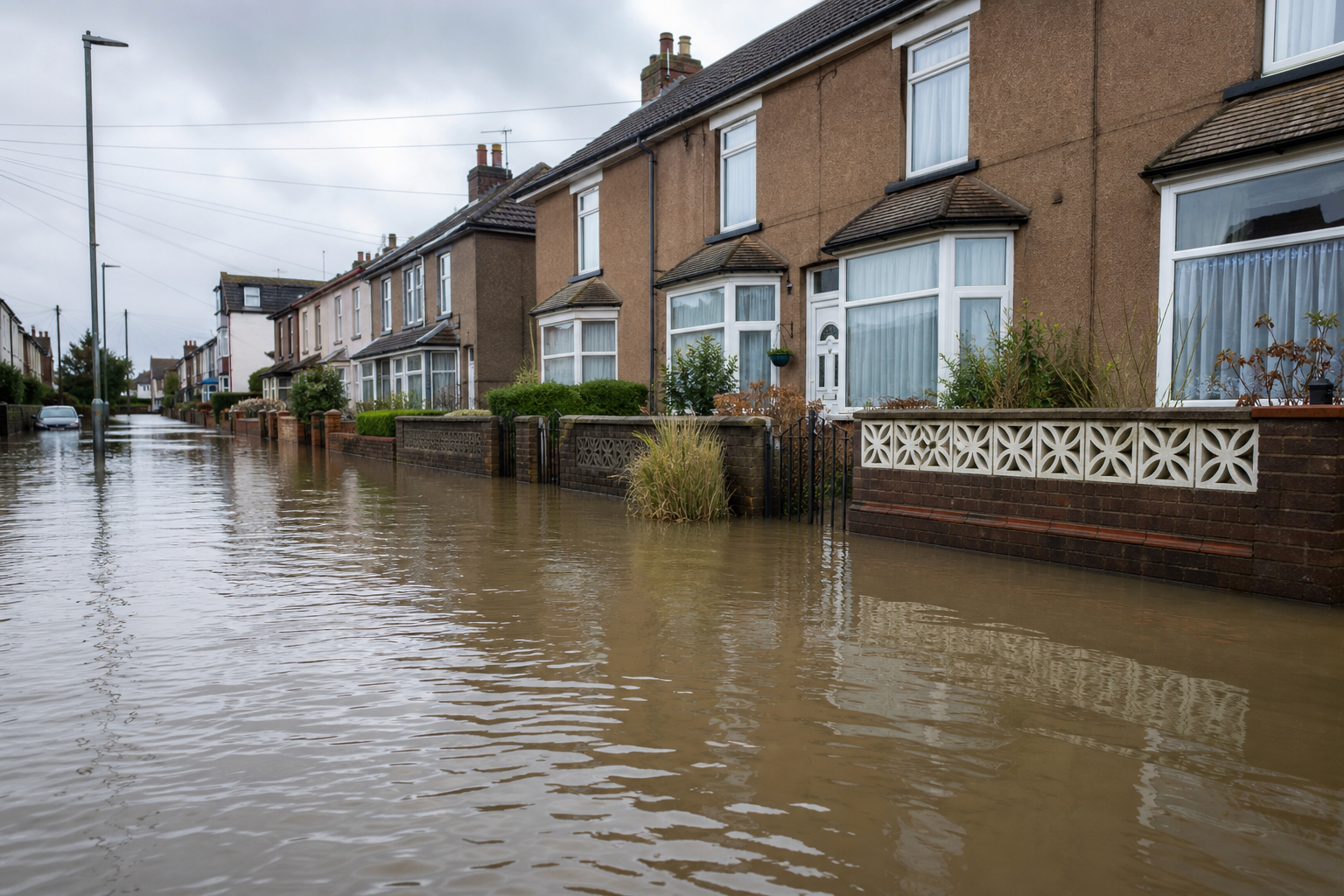
England & Wales — not legal advice. Flooding and drainage are material planning considerations that can carry significant weight — particularly for developments in or near flood zones, on sites with known surface water drainage problems, or where intensification of use would increase impermeable surfacing and runoff. This guide explains how flood risk is assessed in planning, what documents to look for, and how to construct a flood-related objection that officers will take seriously.
For the broader context on objecting, see how to object to a planning application and material planning considerations.
Why flood risk and drainage are material
The National Planning Policy Framework (NPPF) sets out a sequential approach to flood risk: new development should be steered away from flood-prone areas where possible. Where development in flood-risk areas is unavoidable, it must pass the sequential test and, for higher-risk development, the exception test. Planning Policy Guidance on flood risk and coastal change provides the detailed methodology.
Most local plans also contain specific flood risk policies, often cross-referenced to Environment Agency (EA) flood zone maps and the local surface water flooding data.
Understanding the EA flood zone maps
The Environment Agency publishes flood zone maps for England at Check for flooding in England. The zones indicate the probability of flooding from rivers and the sea:
| Zone | Flood probability | Development implications |
|---|---|---|
| Zone 1 | Less than 0.1% annual probability | Low risk; most development acceptable in principle |
| Zone 2 | 0.1% to 1% annual probability (rivers) | Medium risk; sequential test applies; FRA required for many uses |
| Zone 3a | Greater than 1% annual probability | High risk; sequential and exception tests apply; most vulnerable development restricted |
| Zone 3b Functional Floodplain | 5% or greater, or designed to flood | Highest risk; only water-compatible and essential infrastructure permitted |
The EA also publishes surface water flood risk mapping, which is separate from the fluvial (river) zone maps and important for sites where the primary risk is from heavy rainfall rather than river overflow.
The flood risk assessment
For development in Flood Zones 2 and 3, and for larger sites in Zone 1, the application should include a Flood Risk Assessment (FRA). The FRA must:
- Assess flood risk to the site from all sources (fluvial, surface water, groundwater, sewer flooding)
- Demonstrate the development will be safe for its lifetime
- Show that flood risk will not be increased elsewhere
- Identify appropriate flood mitigation measures
When reviewing an application, check whether an FRA has been submitted and whether it has been reviewed by the Environment Agency. The EA is a statutory consultee on applications in Flood Zones 2 and 3 and publishes its consultation responses on the planning register.
The sequential test
Before granting planning permission in a flood-risk area, the LPA must be satisfied that there is no reasonably available site in an area of lower flood risk that could accommodate the development. If you have grounds to question whether the sequential test has been properly applied — for example, if there are obvious alternative sites in lower-risk areas that have not been considered — this is a relevant point to raise with factual support.
Surface water drainage
Even on low flood risk sites, drainage of surface water from a new development is a material consideration. Development typically increases impermeable surfaces (roofs, driveways, paved areas), which increases the volume and speed of surface water runoff. Sustainable drainage systems (SuDS) are required for most new developments in England.
Applications should include a drainage strategy or surface water drainage plan. Key things to look for:
- Has a SuDS scheme been proposed (soakaways, permeable paving, green roofs, swales, detention basins)?
- Does the drainage strategy achieve greenfield runoff rates or another locally applicable standard?
- Has the drainage strategy been reviewed by the lead local flood authority (LLFA) — typically the county council — which is the statutory consultee on surface water drainage?
- Are there existing drainage constraints in the area (combined sewers, culverted watercourses) that the drainage strategy must address?
Making an effective flood objection
The most effective flood-related objections engage with the documents submitted rather than simply expressing concern.
Challenge the FRA assumptions: If the FRA uses historical flood records that do not reflect known local flooding events, or if it relies on modelling data that appears inconsistent with local knowledge, raise this specifically. Photographs, historical records, or insurance data about flooding at or near the site can support a factual challenge.
Highlight consultee concerns: If the Environment Agency or LLFA has raised objections or concerns in their consultation responses, you can support those representations. If consultee responses have not yet been received, note that you would like to comment on them once received.
Cite local plan policy: Identify the specific flood risk and drainage policies in your local plan and explain how the application conflicts with them.
Local knowledge: First-hand accounts of flooding in an area can be relevant where they are factual, proportionate, and specific about location, frequency, and source. Historic flooding evidence is more useful than a general concern.
Foul drainage and sewerage capacity
Separately from surface water drainage, the development's connection to the foul sewer network may be a material consideration where sewerage capacity is constrained. In England, this is primarily a matter for water companies (as statutory sewerage undertakers) — but where a development would require infrastructure that does not yet exist, this can be raised as a material consideration.
Environment Agency responses
The EA is a statutory consultee for applications in Flood Zones 2 and 3 and for applications involving significant changes to watercourses. Where the EA objects to an application on flood risk grounds, their response carries significant weight. An EA holding objection can stall the application until resolved.
The government's flood risk guidance for planning is at Planning Practice Guidance — Flood risk and coastal change. The EA's flood map tool is at Check for flooding in England.
Planning Guard's free scan identifies material grounds — including flood risk and drainage — for your specific case. Not legal advice; verify all citations against current EA maps and your council's local plan before lodging.
More from this series
- Loss of privacy & overlooking planning objections (UK neighbour guide)
- Right to light vs planning objection: what neighbours need to know (UK)
- Reasons to object to planning permission (UK): what actually counts
- What happens after the planning objection deadline? (UK)
- How to find planning applications near me (UK)
- Planning objection letter template (UK)
- What counts as a material change of use in planning law? (England guide)
- Your rights as a neighbour during construction after planning permission is granted (UK)
When you are ready to turn this into a structured objection draft, start with the free material-grounds scan — no account needed to scan.
Email updates
Get occasional emails when we publish new planning guides and product updates. No spam — unsubscribe in one click from any message.
Explain your concerns clearly and in your own words
Free material-grounds scan — see what may count as material planning considerations. Optional editable letter from £7.99; you submit to the council yourself.Planning Guard is a drafting aid, not legal advice.
Not legal advice. Planning Guard is a planning tool to help you explore material planning issues and draft letters — not a solicitor or planning consultant. See Terms.