
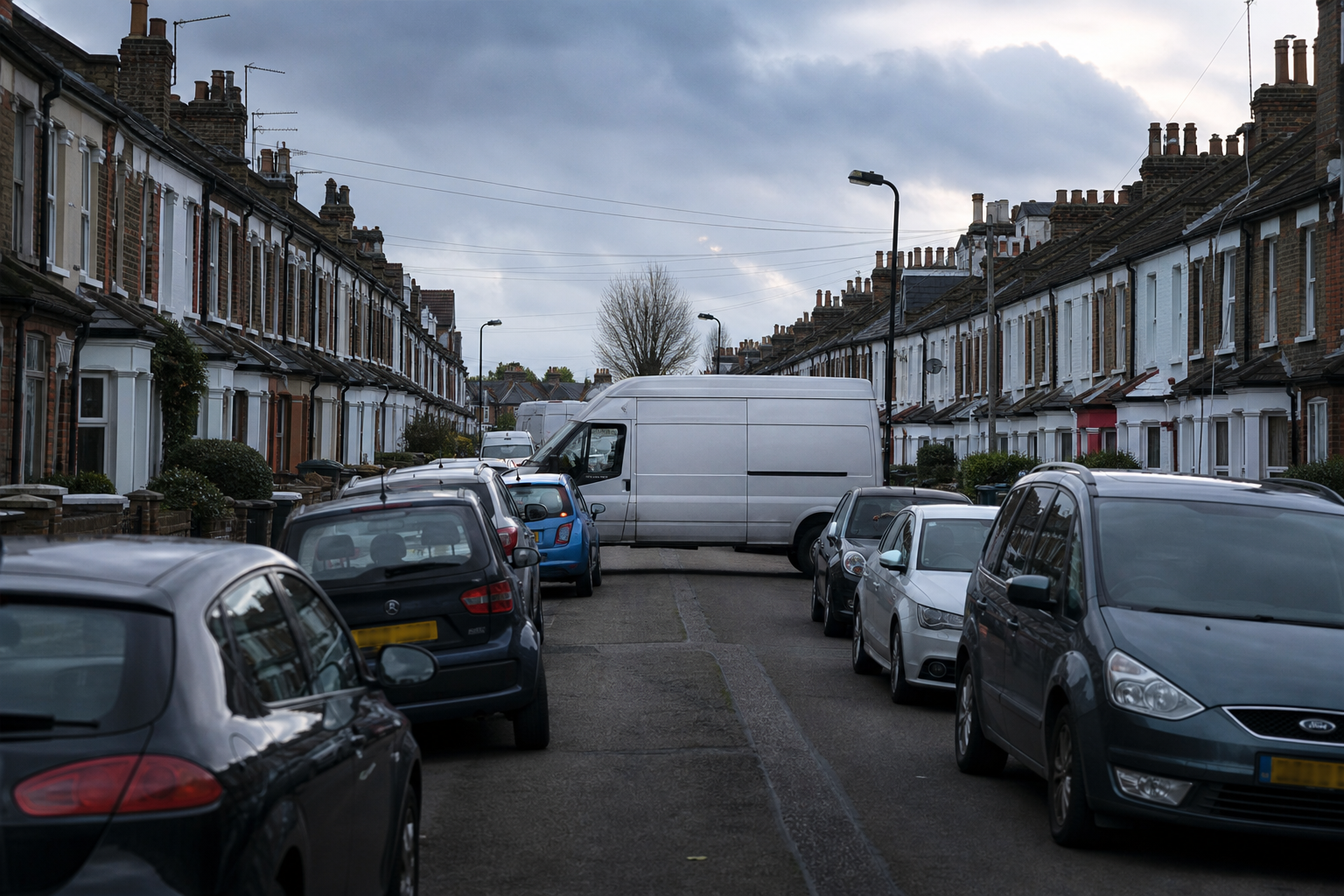
Parking and Highways in Planning Objections: The Evidence Guide (UK)
Quick summary
- Parking and highway safety are material planning considerations — but vague claims that "traffic will be terrible" carry almost no weight with planning officers.
- Strong objections compare the proposed parking provision against the LPA's adopted parking standards, cite specific junction or visibility issues with drawing references, and request conditions where outright refusal is unlikely.
- The evidence that moves decisions is quantitative and specific: parking counts, turning circles from plans, visibility splay measurements, trip generation figures from the submitted transport statement.
- Run a free AI scan to identify whether parking or highways grounds are relevant to your specific application.
Parking and road access generate more planning objection emails than almost any other topic — and more of those objections are ignored by planning officers than any other type. The gap between what neighbours experience as a parking problem and what the planning system treats as a material consideration is frustratingly wide. This guide bridges that gap with practical, evidence-based tools.
Why vague parking objections fail
Planning officers are required by law to consider material planning considerations when assessing an application. "The roads round here are already terrible" is not a material planning consideration — it is a description of a context. What makes it material is the link between the specific proposal and specific identifiable harm, tested against specific adopted policy.
The officer's job is to weigh the planning balance. A well-evidenced parking objection gives the officer something to weigh. A generic complaint gives them nothing — they note it, describe it as "concern about parking and traffic" in the delegated report, and move on.
Common reasons parking objections fail:
- No policy reference — which specific parking standard policy is violated, and by how much?
- No drawing reference — which drawing shows the access, turning, or parking layout being challenged?
- No evidence — where is the parking stress shown? A timed survey or photographic record speaks; an assertion does not.
- Wrong target — objecting to existing parking problems attributable to other causes conflates the issues. The test is the additional impact from this development.
The legal framework: when is parking a planning ground?
Parking and highways are material planning considerations where they affect:
- Highway safety — inadequate access visibility, turning space, or parking provision that would create an unacceptable safety hazard on the public highway.
- Parking standards compliance — the number of spaces provided is below the minimum (or above the maximum) in the LPA's adopted parking standards.
- Traffic generation — the proposal would generate additional vehicle movements that the road network cannot accommodate safely.
- Servicing and delivery — for commercial uses, whether vehicles can manoeuvre safely on and off site without causing highway obstruction.
The National Planning Policy Framework (NPPF) (Chapter 9 — Promoting sustainable transport) requires applications to be assessed for their transport impacts. Local plans include transport policies, and most councils have adopted parking standards supplementary planning documents (SPDs) that set out minimum and maximum parking provision by land use type, dwelling size, and sometimes accessibility zone.
Step 1 — Find and read the application's transport documents
Before writing a word of objection, download these documents from the planning register:
- Transport statement (TS) or transport assessment (TA) — required for applications with significant transport implications. The TS/TA analyses trip generation, access, and parking. Your job is to challenge its assumptions where you disagree.
- Parking survey — if submitted, check the survey methodology: when was it conducted, how many days, which streets, what time periods?
- Design and access statement — often contains information about parking layout and access design.
- Plans — specifically the site plan — shows parking spaces (check dimensions against standard required sizes), turning area, access width, and relationship to the public highway.
If a transport statement has not been submitted for an application that, by size or type, would normally require one, that absence is itself a ground for objection: you can ask the LPA to require one as a pre-commencement condition, or argue the application is insufficiently supported for a decision.
Step 2 — Locate your council's parking standards
Every LPA has adopted parking standards, usually in one of three places:
- The local plan — a chapter or appendix on transport and parking.
- A supplementary planning document (SPD) — a separate document titled something like "Parking Standards SPD" or "Transport SPD."
- A development management policies document — part of the development plan.
To find them: search your council's website for "[council name] parking standards" or "[council name] transport SPD." The MHCLG planning practice guidance on transport is also relevant for national context.
Parking standards typically specify:
- Minimum spaces per dwelling type (1-bed, 2-bed, 3-bed, 4-bed+) for residential developments
- Maximum spaces in accessible/town centre zones (to discourage car dependency)
- Cycle parking requirements
- EV charging requirements (increasingly common post-2022)
- Visitor parking allowances
- Commercial uses — ratios per GFA (gross floor area) or per employee
Once you have the adopted standard, compare it against the application:
| Standard | Required by policy | Proposed | Shortfall |
|---|---|---|---|
| Spaces for 3+ bed dwellings | 2 per dwelling × 6 units = 12 | 8 | 4 |
| Cycle spaces | 1 per bedroom = 18 | 6 | 12 |
| EV charging points | 1 per space = 8 | 0 | 8 |
This table format — showing the specific policy, the calculation, and the shortfall — is what planning officers need to include a parking objection in their report. Reproduce it in your objection with exact policy references.
Step 3 — Assess the access and visibility
Access and visibility are technical grounds, but accessible with basic measuring tools and plan reading.
Visibility splays
A visibility splay is the clear sightline a driver needs from a junction or access point to see oncoming vehicles and pedestrians. Your highway authority will have adopted visibility standards, usually drawn from Manual for Streets (MfS) and Design Manual for Roads and Bridges (DMRB) principles.
The planning application's site plan should show the proposed visibility splay dimensions. To challenge them:
- Check the dimensions against the applicable standard (your council may specify a "y-distance" for the road's speed limit — e.g. 2.4m × 43m for a 30mph road).
- Identify obstructions that would prevent the splay being achieved: existing walls, parking bays, vegetation, commercial frontages.
- If the splay cannot be achieved on the submitted plans, say so with reference to the drawing number and the standard.
Access width
For residential developments, driveways serving multiple dwellings typically require 5m–6m width for two-way passage. Single access serving more than 5 units raises questions. Check the width on the site plan against your council's adopted standard or MfS guidance.
Turning area
On-site turning areas allow delivery and refuse vehicles to enter, turn, and exit in forward gear. Where the application shows a road or court that does not allow adequate turning:
- Identify the shortfall from the plan.
- Note that without adequate turning, service vehicles will need to reverse onto the public highway — a safety risk.
- Reference your council's adopted vehicle tracking requirements or the Manual for Streets swept-path guidance.
Step 4 — Challenge the transport statement where warranted
Transport statements and assessments are prepared by transport consultants on behalf of applicants. They are not infallible. Common challengeable points:
Trip generation assumptions
Transport assessments use TRICS (the Trip Rate Information Computer System) to forecast vehicle trips generated by a development. These forecasts rely on choosing appropriate comparator sites. If the TS uses comparators that are:
- In different accessibility zones (e.g. using rural comparators for an urban site)
- For different land uses or sizes
- Outdated (pre-2015 data for a 2026 assessment)
…you can challenge the outputs. You do not need access to TRICS yourself — you can state that the submitted assessment's methodology appears to underestimate trip generation by using comparators that differ significantly from the site in question, and ask the LPA to require supplementary analysis.
Survey timing
Parking surveys should be conducted during neutral periods — not school holidays, not unusually warm or cold weather, not during local events that change background parking patterns. Check when the survey was conducted. If it was in August (peak holiday season, lower background traffic) or December (anomalous retail peaks), you can argue it does not reflect typical conditions.
Background traffic growth
Transport assessments should include a forecast of future traffic growth to assess cumulative impact over the development's lifetime. If the TS uses an unusually low growth forecast, or no growth assumption at all, this may understate the future impact.
Step 5 — Conduct your own evidence
Where you have genuine concerns and can invest a few hours, your own evidence strengthens any objection:
Parking beat survey
A simple parking beat survey counts the number of vehicles parked in a defined area at regular intervals. To conduct one:
- Define the survey area (the relevant streets, typically within 400m of the application site).
- Walk the area every 1–2 hours from 7:00am to 10:00pm for 2–3 days (a Tuesday, Wednesday, and Thursday in term time).
- Record the number of parked vehicles and the number of spaces (marked and unmarked).
- Calculate the occupancy rate at each interval.
Present the results in a table, note the peak occupancy rate and when it occurred, and compare to your council's standard on parking stress (many councils treat 80–85% occupancy as the stress threshold above which new parking demand is unacceptable).
Photographic record
Time-stamped photographs showing on-street parking congestion — particularly during peak times — are simple but effective supporting evidence. Date and time your photographs consistently.
Highway near-miss records
If there is a history of near-misses or minor collisions at the access point or nearby junction, a written factual account (dates, what you witnessed) adds weight to a highway safety argument. Contact your ward councillor to ask whether any highway safety concerns have been reported to the council's highways team for the relevant stretch.
Framing your parking objection: worked examples
Weak framing (what not to write)
"Parking is already a nightmare in this street. Adding more flats will make it even worse. There is never anywhere to park and this development will only add to the problem."
This objection will be noted in the delegated report as "general concern about parking pressure" and given little weight. It contains no policy reference, no evidence, no drawing reference, and no specific shortfall.
Strong framing (policy + evidence + shortfall)
"The proposed development of 6 dwellings includes 8 car parking spaces. Policy T4 of the [Council Name] Local Plan 2022 requires a minimum of 2 spaces per dwelling with 3 or more bedrooms. The application proposes 6 three-bedroom units, requiring a minimum of 12 spaces under Policy T4. The proposed provision therefore falls short of the adopted standard by 4 spaces.
To evidence existing parking stress in the vicinity, I conducted a parking beat survey on [dates] between 7:00am and 10:00pm on [Tuesday/Wednesday/Thursday]. The average peak occupancy on [Street Name] within 200m of the site was 92%, significantly above the council's 85% stress threshold set out in the Parking Standards SPD (paragraph 4.2). I attach the survey data as an appendix.
I respectfully request that the application be refused on grounds of inadequate parking provision, or alternatively that a condition be imposed securing a parking management plan and monitoring condition before first occupation."
This objection is specific, policy-referenced, evidence-backed, and requests a concrete outcome. It gives the officer a formal reason for refusal or a condition basis.
When to request conditions rather than refusal
Where outright refusal is unlikely (for example, the shortfall is marginal or the applicant could easily remedy it), focusing your objection on conditions is more realistic:
- Parking management plan — required before first occupation, specifying allocation of spaces and visitor management.
- EV charging condition — securing a minimum number of EV-ready or EV-equipped spaces.
- Cycle storage condition — securing covered, secure cycle parking before occupation.
- Turning area condition — detailed swept-path analysis to be approved before development commences.
- Traffic regulation order — request that the LPA consults the highways authority about introducing or extending parking restrictions on the public highway adjacent to the site.
Conditions are a legitimate and often underused tool for neighbours. Even if the application is approved, well-framed conditions can significantly mitigate the impact.
Frequently asked questions
Is parking a valid reason to object to planning permission?
Yes, where parking provision is below the LPA's adopted standards, where the access fails visibility or width requirements, or where the proposed development would generate traffic that the highway cannot safely accommodate. Vague concerns about parking being "difficult" are not material planning considerations, but specific policy-referenced arguments about parking shortfalls are.
How many parking spaces are required for a new development?
This varies by LPA and depends on dwelling size, land use, and accessibility zone. Most councils publish parking standards in their local plan or a supplementary planning document. For residential developments, minimum requirements typically range from 1 space per 1–2 bed dwelling to 2+ spaces for larger units. Some councils in accessible city centres impose maximum standards instead of minimums.
What is a transport statement?
A transport statement is a document submitted by the applicant that analyses the transport impacts of the proposed development — trip generation, access, parking provision, and the effect on the highway network. It is usually required for applications above a certain size or in sensitive locations. You can challenge its methodology, assumptions, and conclusions in your objection.
Can I object because traffic already is bad in my area?
Existing highway problems can be relevant context, but the primary question is whether this application makes the situation materially worse. Simply describing existing congestion without linking it to the specific development's additional impact is unlikely to be given weight. Show that the additional trips or parking demand from this proposal tips an already-stressed situation over the threshold.
What is a visibility splay?
A visibility splay is the clear sightline required at a road junction or access point so that drivers can see approaching traffic and pedestrians in time to stop safely. Local highway authorities adopt minimum splay dimensions based on road speed limits, typically set by reference to Manual for Streets. If the proposed access cannot achieve the required splay, that is a highway safety ground for refusal.
England and Wales — not legal advice. Parking standards, highway authority requirements, and transport policies vary by LPA. Always verify the specific adopted standards for your council before citing them in a formal objection.
Run a free AI scan to see whether parking and highways grounds are relevant to your case — the scan analyses your concerns against the specific application details and your council's adopted policies.
More from this series
- Loss of privacy & overlooking planning objections (UK neighbour guide)
- Right to light vs planning objection: what neighbours need to know (UK)
- Reasons to object to planning permission (UK): what actually counts
- What happens after the planning objection deadline? (UK)
- How to find planning applications near me (UK)
- Planning objection letter template (UK)
- What counts as a material change of use in planning law? (England guide)
- Your rights as a neighbour during construction after planning permission is granted (UK)
When you are ready to turn this into a structured objection draft, start with the free material-grounds scan — no account needed to scan.
Email updates
Get occasional emails when we publish new planning guides and product updates. No spam — unsubscribe in one click from any message.
Explain your concerns clearly and in your own words
Free material-grounds scan — see what may count as material planning considerations. Optional editable letter from £7.99; you submit to the council yourself.Planning Guard is a drafting aid, not legal advice.
Not legal advice. Planning Guard is a planning tool to help you explore material planning issues and draft letters — not a solicitor or planning consultant. See Terms.