
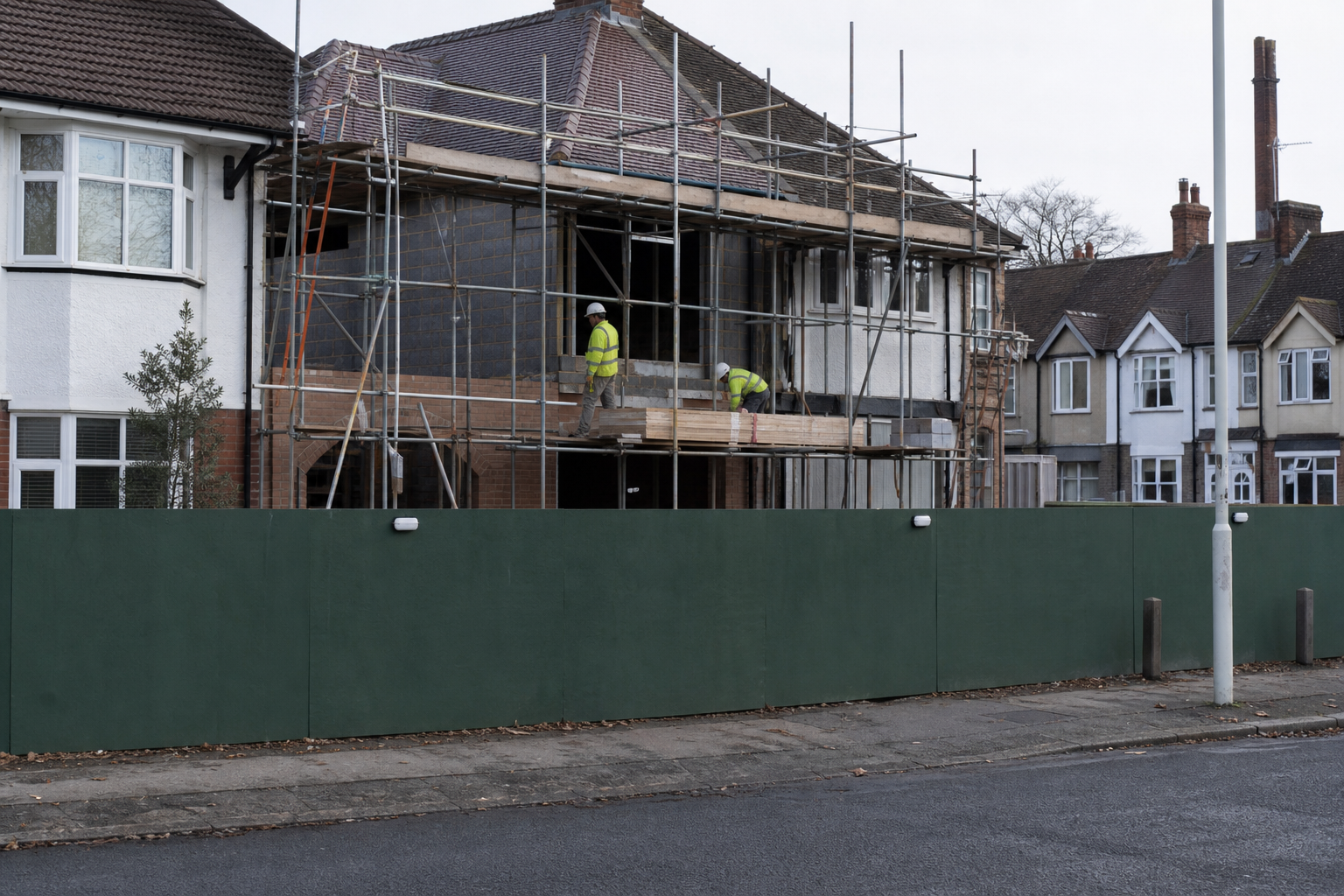
Your Rights as a Neighbour During Construction After Planning Permission Is Granted (UK)
Key points
- Planning permission being granted does not mean you lose all rights — several planning conditions typically restrict construction hours, methods, and deliveries.
- The Party Wall etc. Act 1996 gives you specific legal rights if works affect a shared wall, the boundary, or excavations close to your property.
- Construction noise during permitted hours is controlled by the Control of Pollution Act 1974, enforced by your council's environmental health team — not the planning department.
- Pre-commencement planning conditions (e.g. construction management plan, ecological survey, drainage details) must be discharged before work can legally begin.
- If a developer breaches planning conditions — working outside permitted hours, without discharging conditions, or departing from approved plans — you can report it to the planning enforcement team.
- Run a free AI scan if you are at the objection stage and want to identify grounds before permission is decided.
If a planning application near you has been approved, or if permission has been granted and works are about to start, this guide explains what rights you still have and who to contact for different types of problem. Planning permission is not the end of the story for neighbours.
Planning conditions: what they restrict and who enforces them
Almost every planning permission comes with conditions. Conditions are enforceable legal requirements — breach of a condition is a planning enforcement matter, just as carrying out development without permission is.
Construction hours conditions
The most useful condition for neighbours is the construction hours condition. Most permissions include one, typically in a form such as:
"Construction works, including deliveries to the site, shall be carried out only between 08:00 and 18:00 Monday to Friday and 08:00 to 13:00 on Saturdays. No construction works shall be carried out on Sundays or Bank Holidays."
Permitted hours vary by LPA, site type, and proximity to sensitive uses, but the most common standard for residential developments is:
| Day | Typical hours |
|---|---|
| Monday–Friday | 08:00–18:00 |
| Saturday | 08:00–13:00 |
| Sunday | No works |
| Bank Holidays | No works |
What to do if hours are breached:
- Download the decision notice from the planning register and check the exact wording of the construction hours condition.
- Note the date, time, and nature of the activity.
- Report the breach to the council's planning enforcement team — most councils have an online enforcement complaint form.
- Enforcement officers can issue a breach of condition notice and ultimately require the breach to cease.
Do not report a construction hours breach to environmental health — it is a planning enforcement matter, not an environmental health matter, where a planning condition is in place.
Construction management plan (CMP) conditions
Many permissions include a condition requiring a construction management plan to be submitted and approved by the LPA before development begins. A CMP typically covers:
- Hours of operation (more detailed than the standard condition)
- Delivery vehicle routing and access
- Wheel wash facilities to prevent mud on the public highway
- Dust suppression measures
- Site hoarding and compound arrangements
- Community liaison contact details
If a CMP was required as a pre-commencement condition and you believe work has started without it being discharged, check the planning register for the discharge of condition application. If no discharge application has been approved, report it to planning enforcement as a pre-commencement condition breach.
Pre-commencement conditions
Certain conditions must be discharged — approved by the LPA — before any work on site begins. Examples include:
- Contamination survey and remediation strategy
- Ecological mitigation measures (e.g. habitat survey, nesting bird protection method)
- Surface water drainage scheme
- Archaeological watching brief methodology
- Construction management plan
If a developer begins work before satisfying pre-commencement conditions, that is a planning enforcement breach. Check the planning register's "discharge of conditions" applications to see what has and has not been approved.
Condition compliance in general
All conditions are enforceable. If works depart from the approved plans, materials are different from those approved, or activities are carried on outside what the permission allows, report it to planning enforcement. Provide the application reference, the condition number you believe is being breached, and a description of the breach with dates and photographs where possible.
The Party Wall etc. Act 1996: your legal rights
The Party Wall etc. Act 1996 is entirely separate from planning. It gives adjoining owners specific legal rights where works might affect shared walls, boundary structures, or excavations near your property.
When the Act applies
The Act applies where:
- Works on or to a party wall or party structure — a shared wall between terraced or semi-detached properties, or a shared floor/ceiling between flats.
- New building on or near the boundary line — new walls on or straddling the boundary.
- Excavations near a neighbouring building — excavations within 3 metres of a neighbouring building where the excavation goes deeper than the neighbour's foundations; or within 6 metres if the excavation is deeper than a 45-degree line drawn from the base of the neighbour's foundations.
The Party Wall notice requirement
Before carrying out works covered by the Act, the building owner must serve a Party Wall Notice on all adjoining owners. Depending on the work type:
- Party Structure Notice: at least 2 months before works start.
- Line of Junction Notice: at least 1 month before works start.
- Adjacent Excavation Notice: at least 1 month before works start.
If you receive a Party Wall Notice:
- You can consent in writing, in which case no surveyor is needed for that owner.
- You can dissent and either agree to appoint a surveyor jointly or appoint your own. The building owner pays the costs of the party wall surveyor where works are for their benefit.
- You can do nothing for 14 days — silence is treated as dissent.
If no Party Wall Notice has been served and works are under way:
- Write to the building owner/developer requesting a Party Wall Notice immediately.
- If they refuse, seek advice from a party wall surveyor — they can advise on ex post regularisation and your legal options.
- Do not ignore it — unresolved party wall disputes can affect your ability to claim for damage later.
The government publishes Party Wall Act guidance on GOV.UK — this is the authoritative starting point.
Party wall access for surveys
If you agree to the works or a surveyor is appointed, the Act gives the building owner (with reasonable notice) a right of access to your property for the purpose of carrying out the works. This is a statutory right you cannot unreasonably refuse. The Access to Neighbouring Land Act 1992 provides similar access rights for maintenance works.
Construction noise: the environmental health route
Where construction noise occurs within permitted hours (i.e. no planning condition is being breached), the route is through environmental health, not planning enforcement.
The Control of Pollution Act 1974 (CoPA 1974) gives councils powers to control construction noise. Your council's environmental health team can:
- Issue a prior consent (Section 61 CoPA 1974) to a developer — a pre-agreed noise management scheme that sets permitted noise levels, hours, and methods. Developers often seek Section 61 consent proactively to prevent enforcement action.
- Issue a notice (Section 60 CoPA 1974) restricting or controlling construction noise.
- Prosecute for breaches of a Section 60 notice.
Your practical options for in-hours construction noise:
- Contact the developer directly and ask whether a Section 61 prior consent is in place. If so, check whether its conditions are being met.
- Contact your council's environmental health / noise team (not planning) if noise is excessive or continuous even within permitted hours.
- Keep a noise diary with dates, times, duration, and description of the activity causing noise. This is the evidence base for any complaint.
- If dust is a problem, environmental health also handles statutory nuisance dust under the Environmental Protection Act 1990.
Ecological protection during construction
Where the planning permission or pre-commencement conditions include ecological requirements — for example, a bat or nesting bird survey, habitat compensation measures, or biodiversity net gain monitoring — these create rights and obligations:
European Protected Species (EPS) licences
If the application involves demolition or works affecting buildings or vegetation where bats, barn owls, or other protected species might nest or roost, a European Protected Species licence from Natural England may be required. Works affecting protected species without a licence are a criminal offence under the Wildlife and Countryside Act 1981 — enforced by Natural England and the police, not the planning authority.
If you believe demolition or tree removal is proceeding without appropriate ecological surveys or licences:
- Report to Natural England's wildlife licencing team.
- Report to the planning enforcement team if a pre-commencement ecological condition has not been discharged.
- Contact the RSPB or local wildlife trust who can advise and may raise concerns independently.
Nesting bird protection
All nesting birds and their eggs are protected under the Wildlife and Countryside Act 1981. Vegetation clearance (hedge removal, tree surgery) during the nesting season (typically 1 March to 31 August) requires an ecological check to confirm no active nests are present. This applies regardless of planning permission — it is a wildlife law obligation. If clearance proceeds without checking, report it to the police wildlife crime officer.
Departing from approved plans
Planning permission is granted for a specific, described scheme shown in the validated plans and documents. Developers sometimes carry out works that differ from the approved plans — larger windows, different materials, altered layouts, additional structures. This is called development not in accordance with the approved plans.
What to do if you believe works differ from the approved scheme:
- Download the approved plans from the planning register.
- Compare them against what is being built — measure distances, note discrepancies.
- Report to planning enforcement with your observations, the application reference, the drawing numbers you are comparing, and photographs.
The developer may need to apply for a non-material amendment (minor changes) or a Section 73 application (material changes to conditions) to regularise the departure. If the departure is significant and harmful, enforcement action can require demolition or change.
What to do if you suspect no planning permission exists at all
If works are proceeding and you are not sure whether planning permission was ever granted, check the planning register first. Search by address on your council's public portal. If no permission appears:
- Report to planning enforcement — they can investigate whether permitted development rights cover the works or whether a breach has occurred.
- Note that most enforcement action must be taken within 4 years for building/engineering operations and 10 years for change of use breaches (these time limits were extended under the Levelling-up and Regeneration Act 2023 for operations commenced after 25 April 2024 — now a unified 10-year period for all breach types).
See planning enforcement vs objecting for a full explanation.
Summary: who to contact for what
| Problem | Who to contact | Legal framework |
|---|---|---|
| Work outside permitted construction hours | Planning enforcement team | Planning condition breach |
| Pre-commencement conditions not discharged before work starts | Planning enforcement team | Planning condition breach |
| Works not matching approved plans | Planning enforcement team | Development not in accordance with permission |
| Construction noise within permitted hours | Environmental health team | Control of Pollution Act 1974 |
| Dust, vibration causing statutory nuisance | Environmental health team | Environmental Protection Act 1990 |
| Party wall / shared structure works without notice | Party wall surveyor / solicitor | Party Wall etc. Act 1996 |
| Protected species affected | Natural England / police wildlife crime | Wildlife and Countryside Act 1981 |
| No planning permission at all | Planning enforcement team | TCPA 1990 enforcement powers |
Frequently asked questions
Can construction work happen on Sundays legally?
Under a standard planning condition, no construction works should take place on Sundays or bank holidays. If Sunday working occurs in breach of a planning condition, report it to the council's planning enforcement team. If no planning condition specifically prohibits Sunday working, the Control of Pollution Act 1974 (enforced by environmental health) still provides recourse for unreasonable noise.
Does planning permission override the Party Wall Act?
No. They are entirely separate legal regimes. A planning permission does not grant rights under the Party Wall Act, and Party Wall Act rights exist independently of planning. A developer must comply with both.
What can I do if my property is damaged during construction?
If you believe damage has been caused to your property by construction works, this is a civil matter between you and the building owner. The Party Wall Act provides a mechanism through the party wall surveyor to survey your property before works begin (a "schedule of condition") — this is the best protection because it documents pre-existing state. Without a pre-works schedule, proving causation is harder. Seek advice from a surveyor or solicitor about civil claims for damage.
How long does planning enforcement have to act?
For building and engineering operations commenced after 25 April 2024, there is a unified 10-year enforcement period (Levelling-up and Regeneration Act 2023 changes). For operations before that date, the previous 4-year period for building operations may apply. Change of use breaches are generally subject to a 10-year period. Always check the current position, as the limitation rules are complex.
Can I attend the site to inspect compliance?
You do not have a right of entry to a construction site — that is private land. Planning enforcement officers do have powers of entry. Your role is to report concerns, not to inspect yourself. Do not enter a site without permission.
England and Wales — not legal advice. Construction rights and planning condition enforcement vary by case and council. Always check the specific conditions on the decision notice for the application affecting you.
If you are still at the objection stage, run a free AI scan to identify the strongest planning grounds before permission is decided — it is much easier to prevent harmful development than to manage it during construction.
More from this series
- Loss of privacy & overlooking planning objections (UK neighbour guide)
- Right to light vs planning objection: what neighbours need to know (UK)
- Reasons to object to planning permission (UK): what actually counts
- What happens after the planning objection deadline? (UK)
- How to find planning applications near me (UK)
- Planning objection letter template (UK)
- What counts as a material change of use in planning law? (England guide)
- Airbnb and short-term let planning objections: UK neighbour guide (2026)
When you are ready to turn this into a structured objection draft, start with the free material-grounds scan — no account needed to scan.
Email updates
Get occasional emails when we publish new planning guides and product updates. No spam — unsubscribe in one click from any message.
Explain your concerns clearly and in your own words
Free material-grounds scan — see what may count as material planning considerations. Optional editable letter from £7.99; you submit to the council yourself.Planning Guard is a drafting aid, not legal advice.
Not legal advice. Planning Guard is a planning tool to help you explore material planning issues and draft letters — not a solicitor or planning consultant. See Terms.